Trinity Sunday
A "reasonably acceptable" doctrine?

Sermon preached at St. Peter's Episcopal Church
June 15, 2025
Trinity Sunday
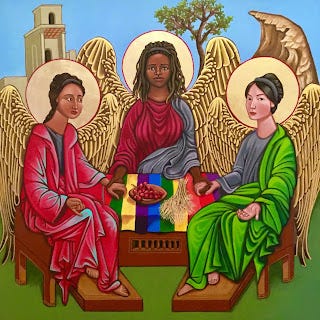
So today is Trinity Sunday, which is celebrated every year on the Sunday after Pentecost, all around the world in both Anglican and Catholic churches. And it’s actually the only Sunday of the whole church year that is devoted exclusively to honoring a church doctrine.
But it’s a pretty complicated church doctrine, which I guess has given it the reputation of being a somewhat challenging Sunday to preach on. When I was preparing this week I was looking at some resources on the Episcopal Church website about Trinity Sunday, and one guide for preachers had this helpful note: “Preachers must use caution and craft careful language to avoid the minefields of heresy around this topic.”
Needless to say… I will likely not be avoiding the minefields of heresy, but then again, that would be just another Sunday at St. Peter’s, so I think we’ll be OK.
Not only is the Trinity the only doctrine that has its own full Sunday celebration, but it’s a doctrine that was never even mentioned in scripture. It’s so easy for me to take the conception of the Trinity for granted, as if it’s been around all this time. Like the first disciples were all just going around greeting each other saying “In the name of the Father, Son, and Holy Spirit," like many of us could do in our sleep.
But this Trinitarian conception of God actually took a few hundred years to unfold.
In those first days and weeks and years after Jesus’s death, his growing group of followers and those around them were still trying in many ways to figure out what the heck had just happened here on Earth.
Who was that guy? Was he really the Son of God? The Chosen One? Does that make him divine? Like fully divine? But was he also human? Fully human? Could he be both? And what about the Holy Spirit? Whose voice was that breaking through the heavens every once in awhile? Was that God too? And if so, does that also make Jesus the Holy Spirit?
These questions were serious and widespread and hotly contested. As theologian Paul Young notes, there was a time when pub brawls regularly broke out over conceptions of the Trinity, which honestly sounds really fun to me.
But it actually wasn’t even until the third century that the word “Trinity” was first coined, by the theologian Tertullian, who was the first Christian author to write widely in Latin. He took the word “Trinity” from the Latin root “trinitas,” and it was meant to signify a “threefold unity” among God the Father or Creator, God the Son or Jesus, and God the Holy Spirit.
It wasn’t until the next century, and God knows how many pub brawls later, that the Trinity was officially made church doctrine at the Council of Constantinople in the year 381. This Council confirmed the Nicene Creed, which is still read weekly in many Episcopal churches today as their “Affirmation of Faith,” as well as the Athanasian Creed, the document which most explicitly laid out the nature of the Trinitarian relationships.
This contentious issue had finally reached some form of churchwide consensus.
The Episcopal Church website (which yes, I spent a lot of time on this week) summarizes this whole period by simply saying: “The church took several centuries to work out a reasonably acceptable way to express the complex relation of Father, Son, and Spirit.”
“Reasonably acceptable” made me laugh, and I realized I should probably read this Athanasian Creed that they were referring to. I actually mentioned to Beatrice a couple weeks ago that I was preaching on Trinity Sunday, and she immediately whipped out the Athanasian Creed and started reading it to me, because I guess she always keeps it close at hand.
But I wanted to share some excerpts with you all to get a sense of what we’re talking about when we talk about this long-awaited contentious Trinitarian doctrine of the church.
The Creed reads…
We worship one God in trinity and the trinity in unity, neither blending their persons nor dividing their essence.
For the person of the Father is a distinct person, the person of the Son is another, and that of the Holy Spirit still another. But the divinity of the Father, Son, and Holy Spirit is one, their glory equal, their majesty coeternal.
What quality the Father has, the Son has, and the Holy Spirit has. The Father is eternal, the Son is eternal, the Holy Spirit is eternal. And yet there are not three eternal beings; there is but one eternal being.
Thus the Father is God, the Son is God, the Holy Spirit is God. Yet there are not three gods; there is but one God.
Accordingly there is one Father, not three fathers; there is one Son, not three sons; there is one Holy Spirit, not three holy spirits.
Nothing in this trinity is before or after, nothing is greater or smaller; in their entirety the three persons are coeternal and coequal with each other.
So in everything, as was said earlier, we must worship their trinity in their unity and their unity in their trinity.
At risk of stepping very near to some heretical minefields… I have to say, I think that even “reasonably acceptable” might be a bit of a stretch. Not the acceptable part. But the reasonable part.
And this is precisely what I love so much about the Trinity! It isn’t based on reason. This official church teaching, this doctrine that has both haunted and held together this tradition for all these centuries, is based, at its core, on contradiction… On paradox! It’s like a math equation gone wrong. Again and again, shamelessly asserting that three equals one, one equals three, three equals one, one equals three.
It can be a lot to take in for those of us whose minds have been so formed and shaped by Western Enlightenment thinking, which asserts that the rational mind is our primary and even perhaps only way of truly knowing and interpreting the world.
So many of us, even those of us also raised in religious settings, have been taught this. That the only true understanding comes from our rational minds, from our intellects, from the things that could fit neatly into a mathematical or scientific formula. And if we can’t figure it out that way, then it either isn’t real or it isn’t worth knowing.
The doctrine of the Trinity flies in the face of this.
For me, more than anything, it serves as a reminder that there are forces moving through this world that are wider and wilder than our limited human minds could possibly imagine. That this great being we simply call “God” is bigger than our most precise language, more complex than our deepest contradictions.
Retired Episcopal priest Suzanne Guthrie writes, “The greatest minds of Christendom have applied reason, philosophical rigor, depth and breadth to understanding and interpreting the church's experience of ‘Father’ ‘Son’ and ‘Holy Spirit.’ But in the end, knowing God is as elusive as predicting a firefly's trajectory over a field of hay after dusk, as futile as keeping track of a drop of rain fallen into the ocean in a storm, as blinding as gazing directly at the sun.”
Really being with the paradox of the Trinity invites me into a different way of experiencing the world, of knowing the world, that is beyond the limits of my reason and rationality. It invites me to drop down into my body, my heart, my breath, my senses, my imagination – all of which are much more adept at sitting with mystery, with strangeness, with seeming-contradiction.
It reminds me of sitting in front of a great mountain or canyon or oceanview. Just looking out at something so vast and fathomless that I literally cannot “get my mind around it” – all I can do is sit in front of it with wonder and awe.
Growing our capacity to be with mystery, with contradiction, with that which we cannot rationally understand, can allow us to be more fully present with the world around us. And not just these great beings of the so-called natural world, but I think with ourselves and each other too.
If we are each made in the image of God, as our tradition also teaches us, then perhaps this model of the Trinity has something to say about us too.
I know that if I tried to write a succinct summary of all the deepest truths about me, it would be at least as hard to follow as the Athanasian Creed.
As Walt Whitman wrote in his poem “Song of Myself”:
Do I contradict myself?
Very well then I contradict myself,
(I am large, I contain multitudes.)
It’s not just God who is a mystery I will never quite understand!
Each one of us embodies a kind of strangeness and beauty and un-reasonableness that could never be contained by the limits of our language, that could never be fully understood by our rational minds.
It feels so fitting, then, that this Trinity Sunday falls during Pride month. A time of honoring the unique ways that divinity is expressed in each of us – in particular those of us whose divine expressions do not fit neatly into our society’s limited labels and languages and norms.
Reverend Rachel Mann, a priest in the Church of England, wrote, “I cannot begin to imagine anything queerer than the doctrine of the Trinity.”
I like imagining the early Church Fathers with that as a goal. Like “What OK guys do you think this is the queerest possible way we could describe God? Or could we make it even gayer?”
But truly, this Trinitarian connection to queerness also reminds me that the stakes of how we relate to this doctrine are high. The stakes of learning to respect strangeness, to honor contradiction, to sit in front of things that we don’t fully understand are high.
How many precious queer lives have been taken from this world because there were those who stood in front of them and could not make “sense” of what they were seeing? Because there were those who forgot that God, too, is stranger than all our social constructs, bigger than all our binaries, beyond all the machinations of our rational minds?
One of the most meaningful conversations I ever had about my queerness was with a beloved elder in my life. She was raised in a very traditional Catholic home and I’m honestly probably one of the first openly queer people who she’s talked in-depth with. Every once in awhile we’ll get to talking about queerness or different queer identities, and she asks me questions about things that I know are very unfamiliar to her lived experiences.
And she’s a pretty jokey person, but one day at the end of one of those conversations, she got uncharacteristically serious and said to me, “Kateri, I just want to make sure you know something.” And I said “What?” And she said, “I may not always understand you. But I will always, always love you.”
I just immediately started crying. It meant so much more to me than if she’d said “I totally get you Kateri, and that's why I love you.” She was saying in that moment that her love was not contingent on the limits of rational understanding, but rooted in something far deeper and wider.
The doctrine of the Trinity, as with nearly all Christian doctrines, has been used in so many harmful ways over these centuries. It has been used to constrain and contain and limit – and claim supremacy over others who do not believe in this exact same formula for relating to the divine.
But I also believe that, at its heart, this doctrine, in all of its beautiful strangeness and contradiction, could help open us up and expand our ways of being in the world to even wider and wilder possibilities. Contemplating the Trinity invites us to drop more deeply into our bodies and our hearts, so that we might better be able to sit in front of all that we will never be able to fully understand – from the Athanasian Creed, to the Grand Canyon, to any person sitting in this room.
Rowan Williams, the former Archbishop of Canterbury, says, “Doctrinal formulae are neither a set of neat definitions nor some sort of affront to the free-thinking soul; they are words that tell us enough truth to bring us to the edge of speech, and words that sustain enough common life to hold us there together in worship and mutual love.”
I am so grateful for this beautiful and paradoxical doctrine of the Trinity, which brings us so far out to the edge of speech and understanding. I am so grateful that even after centuries of arguing, our best description of God is still so barely reasonably acceptable. And I am so grateful for this community, and all those around this country and world today who are sitting together with and in front of this mystery, holding one another in worship and mutual love.
So in the name of the one who created us,
the one who walked with us,
and the one who moves through us still…
Thanks be to you, oh strange and glorious God.